
Gooding County Scheduled and Actual Release
Idaho Department of Correction details do not use a generic “Projected Release Date” label. They use Parole Eligibility Date, Next Parole Hearing Date, and Sentence Satisfaction Date. The Idaho Commission of Pardons and Parole may publish a Tentative Parole Date after a grant. Eligibility marks the earliest ordinary consideration point, a hearing date marks process, satisfaction is a calculated sentence endpoint, and a tentative date remains conditional.
A pretrial Gooding County detainee differs from a sentenced state resident. A bond order or dismissal can authorize release, but the jail event establishes when Gooding custody actually ended. Holds or transfers can prevent a community return.
Find a Gooding County Release Date
First classify the custody and sentence. Applying a state-prison date field to a county booking creates a false answer.
- Check the Gooding case in Idaho iCourt and obtain the signed judgment or relevant order.
- For an IDOC sentence, open the IDOC Resident/Client Search and search by name or IDOC number.
- Match IDOC number and birth year, then open the correct detail record.
- Record the exact labels shown, including PED, next hearing, satisfaction date, or supervision fields.
- Review Commission decisions if parole consideration has occurred, while treating any TPD as conditional.
- For a local jail sentence, ask Gooding County Jail at 208-934-4422 for its calculation and governing policy.
- After the expected date, verify the actual status through the custodian's event record.
The Gooding VINELink search can add a pending custody-event alert, but it does not calculate the sentence.
Idaho Release Date Fields
The field names prevent several common mistakes.
| Idaho field | Meaning |
|---|---|
| Parole Eligibility Date | The earliest possible ordinary parole consideration point, not a promised exit. |
| Next Parole Hearing Date | A process date for Commission review, not a release date. |
| Tentative Parole Date | A conditional date after a Commission grant, subject to remaining requirements. |
| Sentence Satisfaction Date | The calculated endpoint attached to a sentence record, which may be recalculated. |
| Released to Supervision | The date most recently placed on supervision by a court or the Commission. |
| Discharged with date | The stronger public label for completed state-system satisfaction. |
IDOC updates daily but warns that fast-changing status, location, and scheduled termination data may lag. Compare the public detail with the court judgment and current agency information.
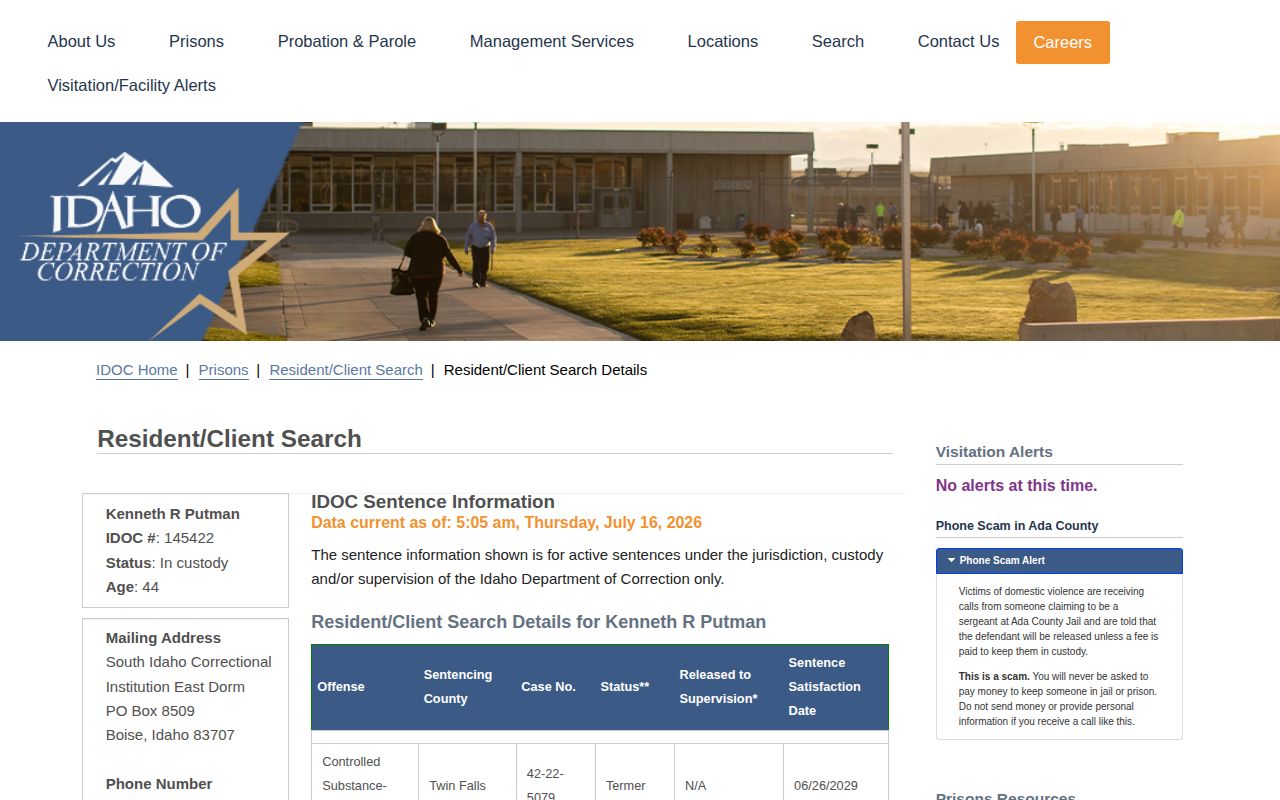
An official IDOC detail example shows the forward-looking labels in their actual context.
Idaho Fixed and Indeterminate Terms
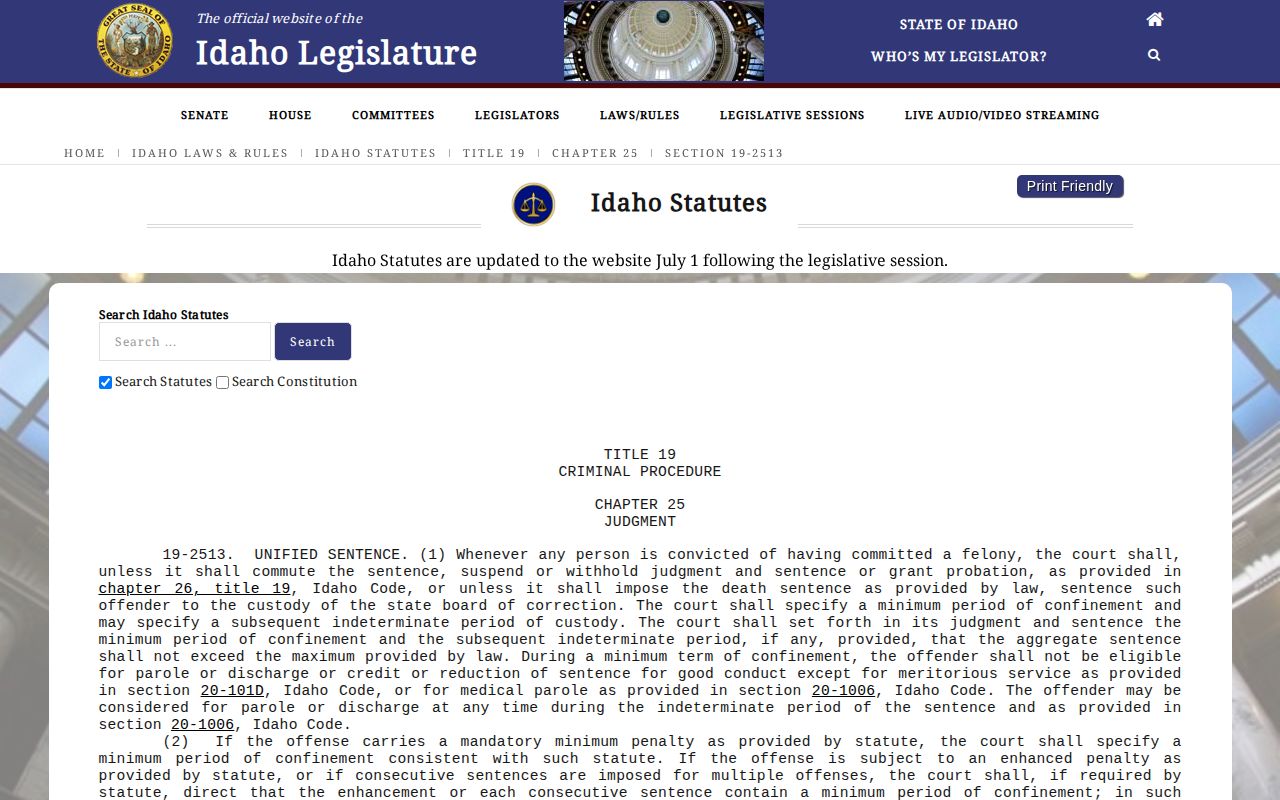
Idaho Code section 19-2513 requires the court to state a fixed minimum and permits a later indeterminate period. During the fixed portion, the person generally is not eligible for parole, discharge, or ordinary good-conduct reduction, apart from narrow statutory exceptions such as extraordinary meritorious service or medical parole. Ordinary parole consideration begins in the indeterminate portion.
This structure cannot be summarized as a routine “serve about 85 percent” rule. For ordinary felony offenses committed after July 1, 1986, the fixed term is effectively served at 100 percent, subject to the narrow exceptions the statute recognizes. The PED generally aligns with the start of the indeterminate portion, but multiple sentences can make the controlling date more complex.
The official unified-sentence statute supplies the controlling fixed-and-indeterminate framework.
Good Time Is Not a Routine Idaho Estimate
Idaho Code section 20-101D permits, but does not require, a reduction for extraordinary heroism involving risk to the resident's life or outstanding service such as saving life, preventing major property loss during a riot, or preventing escape. The cap is 15 days per month sentenced, and an award can be withdrawn under rules. This is not ordinary program credit and should not be inserted into a routine release estimate.
Section 20-101A has a historical good-conduct schedule of five to ten days per month, but it applies to offenses committed before July 1, 1986. It also contains aggregation and forfeiture rules. Label it legacy and rare. Applying that schedule to a modern Gooding County felony would materially misstate Idaho law.
What Changes an Idaho Release Date
A displayed endpoint can move because the legal and factual inputs change.
| Factor | Possible effect |
|---|---|
| Jail-time credit | Changes the credited start or remaining time when lawfully applied. |
| Amended judgment | Replaces prior sentencing terms with the court's revised terms. |
| Concurrent or consecutive cases | Changes which sentence and indeterminate start control. |
| Parole decision | May grant, deny, continue, revoke, or set another review, without itself proving release. |
| Programming and parole plan | Must be completed and approved before a tentative parole release is finalized. |
| Warrant or absconding | Can interrupt supervision and affect the full-term calculation. |
| Detainer or receiving authority | Can turn the end of one custody episode into transfer rather than community release. |
Gooding County Jail Sentence Dates
A local jail sentence uses the sentencing order and Gooding County Jail's calculation. The research found no official Gooding-specific good-time policy, weekend-release rule, Sunday-to-Friday practice, or routine release-hour publication. Ask the jail for the calculation and policy that govern the named booking rather than borrowing the IDOC felony framework.
The court docket can show judgment, credit for time served, amended terms, or later orders. It may not show the actual door time. The jail release record supplies implementation and destination, while the court record supplies authority.
Idaho's Distinct Release-Date Vocabulary
Gooding County readers should preserve Idaho's four-part distinction: PED, next hearing, sentence satisfaction, and TPD. Modern fixed terms do not receive a generic 85-percent reduction. Section 19-2513 and the narrow extraordinary-credit statute control the analysis, and the signed judgment supplies the sentence being analyzed. This local angle prevents a projected-date query from becoming a false promise.
Confirm the Gooding County Event
A Commission grant remains conditional. The Commission states that no one releases before the reflected tentative date and that programming and an IDOC-approved parole plan must be complete before finalization. After the anticipated date, look for “In community” with Released to Supervision or for a discharge status. Call the displayed supervision office when current timing matters.
For a county booking, confirm with Gooding County Jail. For BOP or ICE custody, use those agencies' systems. A hearing date, missing roster entry, bond order, PED, or “Not in BOP custody” cannot substitute for a completed event with date, disposition, and destination.
Multiple Gooding County Sentences
More than one judgment can change which date controls. Concurrent terms can run together, while consecutive terms can delay the start of another portion. The relevant indeterminate start, jail-time credit, amended judgments, and later recalculation all matter. Read every active sentence rather than lifting one date from one line of an IDOC detail.
The court clerk's signed judgments are the authority for sentence terms. IDOC applies those terms in its calculation, and the Commission controls discretionary parole decisions. When a public date seems inconsistent with the judgment, use the IDOC information-request portal or the contact shown on the detail record to ask for clarification.
Parole Decision Is Not Release
Commission outcomes can include a grant, denial, continuation, modification, reinstatement, revocation, or another hearing date. A Notice of Action Taken records the Commission's decision, but actual release still depends on requirements and later implementation. Programming, an approved parole plan, paperwork, discipline, legal changes, or a warrant can prevent the tentative event.
Read the Commission decision first, then the later IDOC status. This sequence distinguishes consideration, conditional approval, community supervision, and eventual sentence discharge. It also avoids treating the full-term or satisfaction date as proof that a person left custody on that exact day. Confirm the completed event through the later IDOC community or discharge status.
Correct a Gooding Release-Date Record
If a public date or status appears wrong, preserve the IDOC number, case number, exact label, and date displayed. Compare them with the signed judgment and any amended order. The IDOC information-request portal is the official fallback for a correction or retained record, while the filing clerk supplies court documents. Do not replace an agency calculation with a personal estimate.
A daily update can lag a fast change, and a lawful recalculation can alter a date that was accurate earlier. Ask which judgment, credit, sentence sequence, or status event controls. With multiple cases, identify whether terms run concurrently or consecutively and which indeterminate start governs. This produces a traceable answer without promising a release that has not happened.